domenica 24 febbraio 2013
venerdì 7 settembre 2012
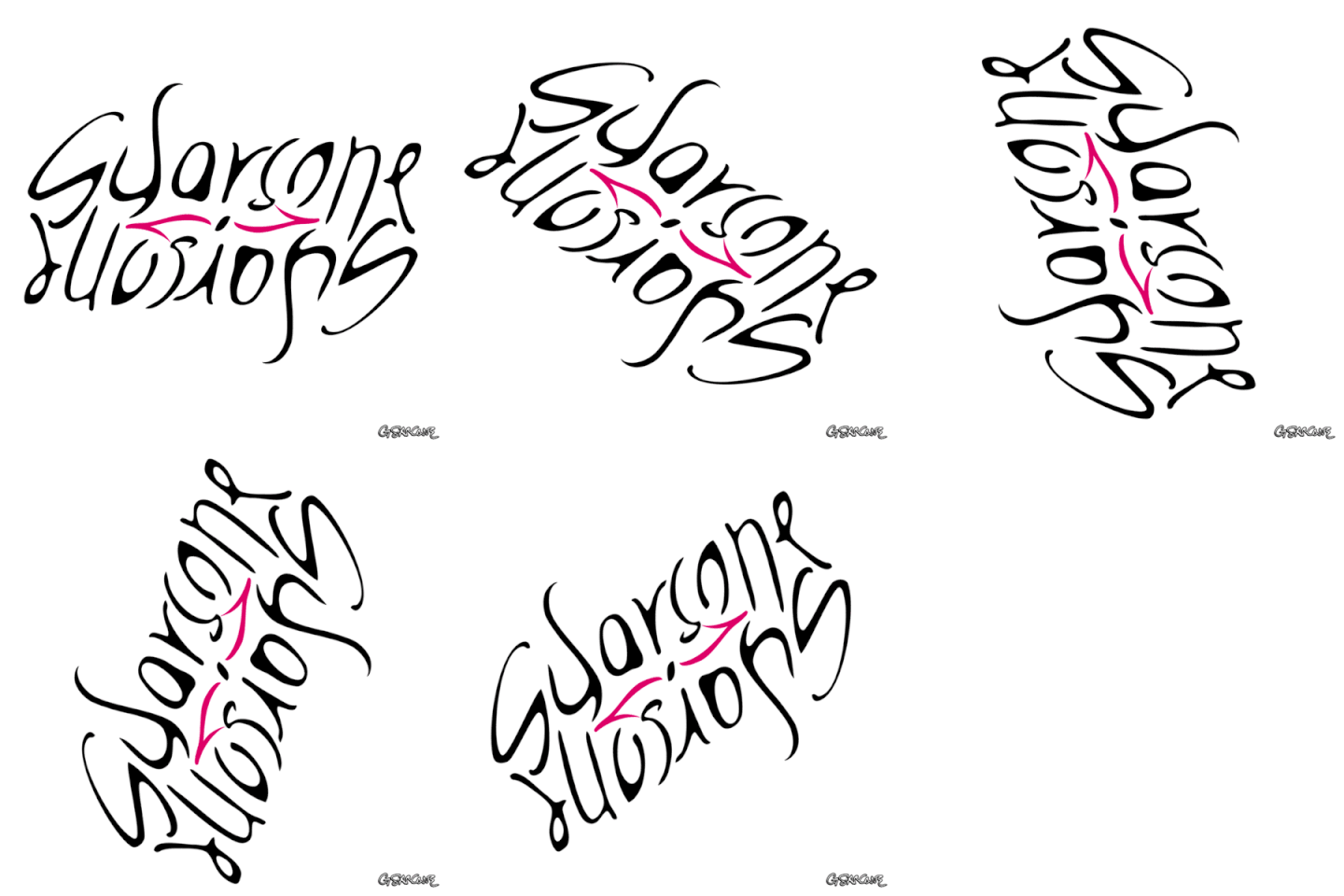
An ambigram may be defined as an “amphibian” word (or group of words) occupying at the same time two different reading planes of a page. The distinctive feature of an ambigram is that it remains unchanged even when inverted, or reveals the coexistence of a second word when either the page is reoriented (by rotations or reflections) or when you simply change your vantage point.
Types of Ambigrams:
Rotational
The most common type is the rotational ambigram. That is a word or phrase written in such a way that it appears identical or completely different when it is read upside-down.
Reflection
Also known as bilateral or mirror-image symmetry, this refers to words that can be read normally before and after reflection in a mirror.
Figure/Ground
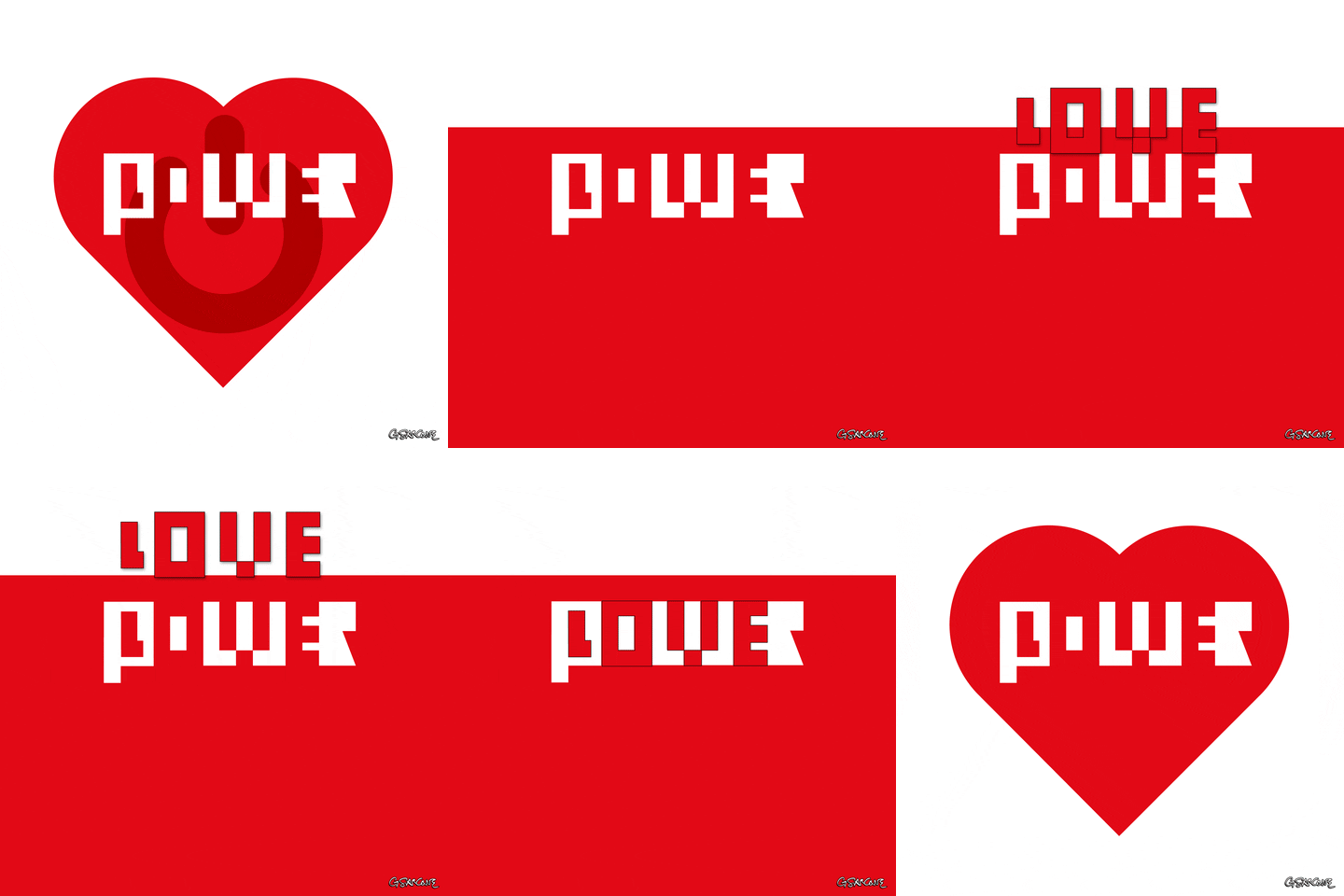
Any ambigram where both the positive (figure) and negative (ground) space read as words.
More information
www.archimedes-lab.org/ambigrams.html
Ambigrams on my Behance gallery
G. Sarcone
Posted by
Unknown
at
02:13
0
comments
Power of Love
An ambigram may be defined as an “amphibian” word (or group of words) occupying at the same time two different reading planes of a page. The distinctive feature of an ambigram is that it remains unchanged even when inverted, or reveals the coexistence of a second word when either the page is reoriented (by rotations or reflections) or when you simply change your vantage point.
Types of Ambigrams:
Rotational
The most common type is the rotational ambigram. That is a word or phrase written in such a way that it appears identical or completely different when it is read upside-down.
Reflection
Also known as bilateral or mirror-image symmetry, this refers to words that can be read normally before and after reflection in a mirror.
Figure/Ground
Any ambigram where both the positive (figure) and negative (ground) space read as words.
More information
www.archimedes-lab.org/ambigrams.html
Ambigrams on my Behance gallery
G. Sarcone
Posted by
Unknown
at
02:13
0
comments
lunedì 6 febbraio 2012
The visual art of concealing (1)
“Steganography” is the art and science of hiding a secret message within a larger one, in such a way that no one suspects its presence. The Swiss banknotes offer some interesting examples of steganography. In the picture below you can see the back of a Swiss ten-franc bill. The small part surrounded by the blue square contains a microtext, if we strongly enlarge it we may read a short bio of the Swiss architect Le Corbusier both in German and in Romansch:
Le Corbusier hat als Architekt Urbanist maler und Theoretiker Bahnbrechende und Visionäre Anwendungen für den Wohn- und Städtebau verwirklicht...
Posted by
Unknown
at
12:12
0
comments
Labels: le corbusier, microtext, steganography, swiss banknotes
lunedì 5 settembre 2011
Making Optical Illusions
although a very persistent one’
Albert Einstein
As you certainly know, optical illusion is a particular style of art that plays tricks on our eyes and consequently baffles our perception. You might almost put the effect down to faulty vision, and in fact these visual tricks are sometimes used to assess the performance of the eye or the brain.
For centuries, visual illusions have been created by means of the ingenuity of the human brain and they have exerted an enduring fascination on the viewer. Since the arrival of the printing press and, later, film and digital imagery, millions of illusions have been produced in the name of art, science, education and, especially in the modern world, entertainment.
Creating a new optical illusion, or even reproducing one that already exists, may constitute a real challenge for your artistic skills, or it may simply represent an original and funny way to express your creativity. With the aid of my new book “Drawing Optical Illusions” and a little patience, you will be able to draw effective and powerful optical illusions in a reasonable amount of time.
This guide contains a collection of recent and ancient optical illusion effects, along with demonstrations and tips to inspire you to create your own work. The different optical illusions are organized by effects and applications, such as moving patterns, impossible or ambiguous figures, color effects and distortion effects, presented in a way that will make it easy for you to put them into practice.
The French painter Edgar Degas once said that art is not what you see, but what you make others see. Yet if any artwork is in itself already an illusion, then visual illusion pictures represent an art style that plays a game with our perception twice over. The illusionist artist has first to persuade the viewer that his or her depiction is real, though what the viewer sees is not the reality but a two-dimensional representation of it, made with the help of visual conventions and rules. At the very moment the viewer is going to be convinced, he or she falls into the perceptual trap of the second illusion, the real one created by the illusionist artist, plunging him or her into a state of cognitive hesitation and surprise. In fact, visual illusions are a kind of mental diversion – they capture the attention and are intriguing, challenging and fun as well. In other words, optical illusions force us to pause and question the nature of reality.
You can see and read some excerpts of my book here.
Posted by
Unknown
at
06:34
0
comments
Labels: drawing optical illusions
martedì 17 maggio 2011
Mask of Love illusion
Below is the optical illusion project we presented to public at the Gala of "2011 Best Illusion of the Year Contest" held at Philharmonic Center for the Arts in Naples, Florida. Actually, the pensive face in a Venetian mask holds an interesting secret. Can you figure it out?
Look at this mysterious Venetian mask. Do you notice something particular? What kind of emotions do its features express? |
| To see what is going on in the picture, just watch the video! |
Posted by
Unknown
at
00:29
0
comments
Labels: best illusion, gianni sarcone, máscara, maschera, mask of love, masque, قناع, 탈, 仮面, 面具
martedì 29 settembre 2009
The Puzzle of Seeing
by Gianni A. Sarcone (Curiopticals)
Our brain is an artist that paints the reality that surrounds us. It transforms energy into color; links distances, movement and form to create reality in 3D; interprets visual stimuli and compares them to memories... and sometimes, it makes mistakes!
Are the eyes an open door to the world, as poets say? Well, honestly, not really. The fact is, we see the world through a pair of tiny peepholes, the pupils of our eyes. Our brain functions as a highly creative ‘camera obscura’. The brain elaborates the visual stimuli we receive, transforming them into true artworks.
The German poet Novalis said that the eye is a ‘superficial’ organ. That is indeed partly true. I will even add that it is an external organ: the eye with which we see the world is a part of the world itself. As soon as we open the eye, whup, the world pops in it!
The eye is a humble and silent organ. It cannot ‘see’ itself, and is itself unnoticed in use. Moreover, unlike a camera, the eye ‘creates’ a field of vision without real edges. That seems paradoxical at first glance, that our field of vision is limited but does not have boundaries... There are no ‘blank’ zones outside of our visual field. Our brain simply cancels out those edges with a smooth fade-out effect.
Some animals see differently than we do. Cats are red/green color blind, and only perceive the blues and yellows of the landscape. | Seabirds' photoreceptors contain yellow oil droplets which help polarize light and improve distance vision, especially in hazy conditions. | |
Bulls have few retinal cones, and as a result, they have no color vision. Also, their vision is much less acute than ours. |
Unfortunately (or fortunately?), seeing isn’t some kind of direct perception of reality. Atcually, our bairns are cnostanlty itnerperting, corrceting and gviing srtuctrues to the viusal ipnut form our eeys (see footnote further below). If this were not the case, we wouldn’t see any colors, and we would probably see the world upside down! We would also notice in our visual field a very large dot, called the blind spot, where the optical nerve enters the eye.
Moreover, vision isn’t an innate process at all. It depends to a large extent on ability acquired through a long and laborious undertaking. We take the concept of vision for granted, but a person who is blind from birth who later in life gains the sense of sight takes many years to learn how to understand and organize the things that he now perceives.
The ability to see is a process far from banal, and far from being passive. When we look at a panorama, its colors take around 30 milliseconds to arrive at the ‘visual cortex’ within the posterior lobes of our brain (also known as ‘striate cortex’ or ‘V1’). The shapes of the scene, and the sensation of the distances – which involve depth and motion – are perceived shortly after, at approx. 70 milliseconds. During these tiny slices of time, the brain filters, analyzes, and interprets the various pieces of the visual puzzle, trying to assemble them into a coherent image. In other words, it is crafting the best and most useful scene possible from the raw image data that our eyes present to us.
I’ve always been fascinated and impressed by how people with partial or total visual sensory deficiencies interact with the world. We cannot talk about visual perception or optical illusions without mentioning the other side of the coin... To understand how these people ‘see’ without sight is to understand just how important our sense of sight is (sometimes we don’t do it justice or give it the importance it deserves) and how it collaborates and integrates with the other sense organs.
Have you ever asked yourself what it is, when we see, walk, speak, feel and touch all at the same time, that links our sight with the sense of touch or hearing? The reality is we actually see very little: only that on which we are concentrating, or which we find important. Man without the crutches of the other sense organs would truly be lost, because it is they which permit us, subconsciously, to go about our everyday lives. An experiment demonstrated how at times we are really ‘blind’ in the truest sense of the word. In this famous experiment on ‘inattentional blindness’, performed in 1999, Daniel Simons and Christopher Chabris asked people to watch a video clip and count the number of times one of two teams of basketball players took possession of the ball. Many people (around 40 percent) didn’t notice at all a man in a gorilla suit entering stage right, doing a jig in the centre of the screen and then leaving, stage left. The clip demonstrated how we don’t see what we don’t pay attention to, even when it’s in front of our eyes!
Posted by
Unknown
at
03:02
Labels: color vision deficiency, colors, seeing